Putting a Playful Quote and Unicorn to Work in Your Projects
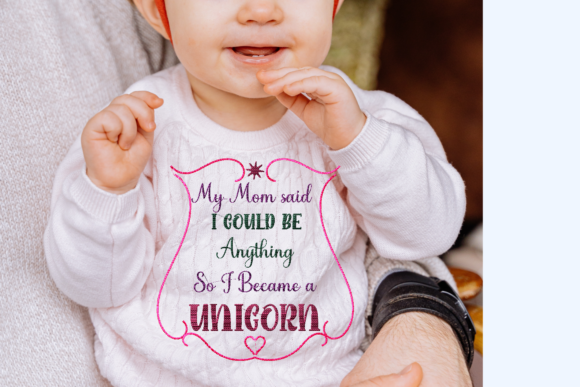
Let’s talk about a design that lands with immediate charm: My Mom Said I Could Be Anything Unicorn. It’s a hybrid of a sweet sentiment and a whimsical creature, packaged as an embroidery file. My first impression? It’s upbeat and lighthearted, but not overly saccharine. The quote has a witty, slightly irreverent edge that feels modern, while the unicorn icon leans into classic fantasy. This combination creates a visual personality that’s versatile—it can be nostalgic for an adult or purely magical for a child.
The Mood It Creates and Where It Naturally Belongs
This isn’t a solemn or formal piece. The mood is playful, empowering, and a little bit cheeky. That makes it a fantastic candidate for gifts, personal wear, and products aimed at adding a smile. The layout, presumably pairing text with an illustrative unicorn, suggests a balanced composition. The detail level is a key consideration: a well-digitized design should have clean lines for the lettering and distinct features for the unicorn to ensure both elements read clearly after stitching, even at a moderate size.
In my mind, it naturally belongs on items that carry a personal touch. Imagine a custom tote bag for a creative friend, a cozy sweatshirt for a mom, or a baby blanket for a nursery. It feels perfect for holiday gifts like embroidered pillow covers or kitchen towels. For small shop product lines, this design could anchor a series of optimistic, animal-themed merchandise. The Animal Quotes category is a popular niche, and this file taps directly into that appealing market.
A Real Scenario: Crafting a Boutique Tea Towel
Picture this: You’re preparing a batch of tea towels for your Etsy shop or a craft fair. You want something that’s functional, decorative, and gift-ready. You load My Mom Said I Could Be Anything Unicorn. On a crisp, light-colored linen, the design would pop. The witty quote adds a conversational element to a household item, while the unicorn provides a universally loved graphic. It transforms a simple towel into a personalized gift or a charming small shop product. The key is testing the stitchout to ensure the lettering isn’t too dense for the fabric and that the unicorn’s finer details, like a horn or mane, don’t get lost.
Performance Across Real-Life Embroidery Situations
How does this design perform when the needle hits the fabric? Its success hinges on thoughtful application.
For custom apparel like t-shirts and sweatshirts, consider placement. On a t-shirt, centered on the chest or on a sleeve, it works as a fun accent. On a sweatshirt, the heavier fabric can support more stitch density, making it a bold statement. For tote bag design, it’s excellent as a focal point, adding personality to an otherwise plain bag. In the realm of baby embroidery—on onesies, bibs, or nursery decor—the unicorn theme is a winner, but you must be meticulous about hoop size and stabilizer to ensure safety and durability on softer fabrics.
As an embroidered patch, this design could be fantastic. The combination of text and image makes for a standalone piece that can be applied to jackets, backpacks, or caps. For caps and hats, the curved surface requires careful testing; smaller lettering might need adjustment to remain legible. For home goods like pillow covers or blankets, it becomes a decorative feature that invites a question or a smile.
For commercial projects, such as a line of products for a boutique or as part of your craft business offerings, it’s a strong design asset. It can be used in printable mockups to market the finished product and, when stitched well, elevates the perceived value and handmade presentation. It feels professional and engaging, which builds customer trust.
Where to Use This Design with Extra Care
Not every project is an ideal canvas. Some situations demand extra caution with a design like this.
- Small hoop sizes: If the design is intricate, forcing it into a very small hoop might compromise the clarity of the tiny lettering and the unicorn’s details.
- Textured or stretchy fabric: Fabrics like terry cloth or activewear knits can distort satin stitches or fill stitches. A robust stabilizer strategy is non-negotiable.
- Dark fabric backgrounds: The quote and unicorn likely rely on contrast. On dark fabrics, you may need to choose brighter, lighter thread colors deliberately to maintain visual impact.
- Products needing frequent washing: On items like aprons or kitchen towels that see heavy use, test durability. Ensure the stitch density isn’t so high that it stiffens the fabric uncomfortably or so low that it wears out quickly.
- Layered garments or curved surfaces: Embroidering on a cap’s curved panel or a collared shirt requires adjusting expectations for how the flat design will appear once applied.
Impact on Visual Appeal, Value, and Engagement
From a designer’s and seller’s perspective, a well-executed stitchout of My Mom Said I Could Be Anything Unicorn does several things. It boosts visual appeal by merging a relatable message with a beloved symbol. The stitching clarity of both elements directly affects the product’s quality feel. A crisp, clean embroidery job increases the product’s perceived value, making it more giftable and desirable as small business merchandise.
For creative entrepreneurs, using such a design consistently across a product line can enhance brand consistency—if your brand voice is playful or uplifting, this fits perfectly. It drives buyer engagement because it’s conversational; people react to it. It can spark recognition and connection, which is gold for Etsy sellers and craft fair products. Ultimately, it supports professionalism by showing you’ve chosen a design with broad appeal and practical application.
Practical Notes Before You Hit Start
Before you commit this design to a client project or your next batch of products, here’s my checklist.
- Always test the design on scrap fabric first. Use the same fabric and stabilizer you plan for the final project.
- Check thread color contrast against your background fabric. Run a test in both light and dark scenarios if you plan to offer both.
- Review stitch density by looking at the stitchout. Are there areas, especially in the unicorn’s fill stitches or letter satin stitches, that seem overly dense or too sparse?
- Confirm the hoop size you intend to use accommodates the entire design comfortably. Don’t assume.
- Inspect small details like the unicorn’s features and the smaller letters in the quote. Are they distinct and not merging into a blob?
- Consider creating black and white mockups or previews to see the pure composition without color influence.
- Use proper stabilizer for your specific fabric. This is the foundation of a good stitchout.
- Crucially, check whether the design license permits your intended use—personal, commercial, or both. Never assume. Confirm before selling finished items.
My Mom Said I Could Be Anything Unicorn is more than just an embroidery file. It’s a tool for creating products with personality. By approaching it with this practical, real-world mindset, you can ensure it performs beautifully in your embroidery project, adding value to your work and delight to your customers.